SOC 2 Type I vs Type II: Which One Do Enterprise Customers Actually Require?
When a Fortune 500 procurement team sends over their vendor security questionnaire, one question almost always appears near the top: "Do you have a SOC 2 report?" But understanding the difference between SOC 2 Type I vs Type II — and knowing which one will actually satisfy your enterprise prospects — can mean the difference between closing a deal and losing it to a competitor. This guide cuts through the confusion with practical, experience-backed guidance on what each report covers, what buyers really want, and how to get there efficiently.
What Is SOC 2 and Why Does It Matter for B2B Sales?
SOC 2 (System and Organization Controls 2) is an auditing framework developed by the American Institute of CPAs (AICPA) to evaluate how service organizations manage customer data. It is built around five Trust Service Criteria (TSC): Security, Availability, Processing Integrity, Confidentiality, and Privacy. The Security criterion — often called the Common Criteria — is mandatory; the others are selected based on your product and customer commitments.
For SaaS companies, cloud providers, and any B2B vendor handling sensitive customer data, SOC 2 has become the de facto baseline for enterprise trust. Without it, you will routinely hit walls in procurement cycles, especially with customers in financial services, healthcare, and technology sectors.
SOC 2 Type I vs Type II: The Core Difference
The distinction between the two report types is fundamentally about time and evidence depth.
SOC 2 Type I: A Point-in-Time Snapshot
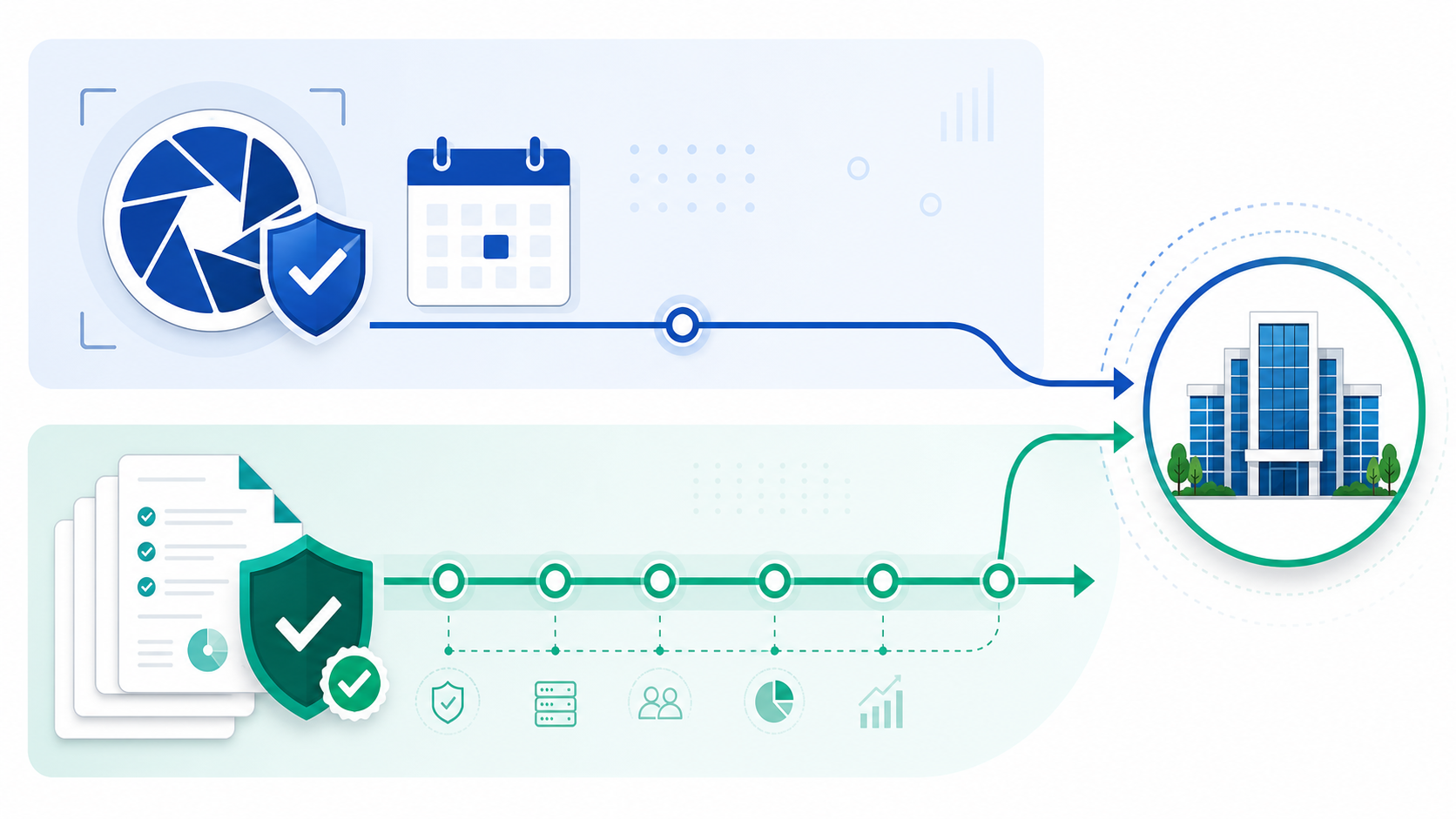
A Type I report evaluates whether your security controls are designed appropriately as of a single date. The auditor reviews your policies, procedures, and control documentation and opines on whether the controls are suitably designed to meet the relevant Trust Service Criteria. Think of it as a photograph: it shows what your security posture looks like on one specific day.
- Audit period: A single point in time (one day)
- What is tested: Design and existence of controls
- Typical timeline: 4–8 weeks from readiness to report issuance
- Cost range: Generally $10,000–$25,000 in auditor fees
- Best for: Early-stage companies needing a quick credibility signal
SOC 2 Type II: Operational Effectiveness Over Time
A Type II report goes significantly further. It evaluates whether your controls were not only well-designed but also operating effectively over a defined observation period — typically a minimum of six months, though twelve months is the enterprise gold standard. The auditor samples actual evidence (access logs, change management tickets, incident records, vendor reviews) to verify that controls functioned consistently throughout the period.
- Audit period: Minimum 3 months; 6–12 months is standard
- What is tested: Design AND operating effectiveness of controls
- Typical timeline: 6–14 months from program launch to report issuance
- Cost range: Generally $20,000–$60,000+ in auditor fees
- Best for: Companies selling to mid-market and enterprise accounts
What Enterprise Customers Actually Require
Here is the honest answer that many compliance guides gloss over: the vast majority of enterprise customers require SOC 2 Type II. A Type I report may open initial conversations, but it rarely satisfies the security review committees at large organizations.
Why Enterprise Security Teams Prefer Type II
Enterprise security and procurement teams are not just checking a box — they are managing third-party risk. A Type I report tells them your controls look good on paper on one day. A Type II report tells them your controls actually worked, consistently, for months. That distinction matters enormously when a CISO is deciding whether to trust a vendor with customer PII, financial records, or protected health information.
In practice, here is what enterprise buyers typically communicate:
| Customer Segment | Typical Requirement | Notes |
|---|---|---|
| SMB / Startup customers | Type I acceptable | Often just want to see something formal |
| Mid-market (100–1,000 employees) | Type II preferred | May accept Type I with a roadmap commitment |
| Enterprise (1,000+ employees) | Type II required | 12-month period increasingly standard |
| Financial services / Banking | Type II required | Often require specific TSC inclusions (Availability, Confidentiality) |
| Healthcare / Life sciences | Type II + HIPAA BAA | SOC 2 alone is insufficient; HIPAA alignment required |
| Government / Public sector | FedRAMP or NIST-aligned | SOC 2 may be supplementary, not primary |
The "Type I as a Bridge" Strategy
There is a legitimate strategic use case for Type I: it serves as a credibility bridge while you accumulate the observation period required for Type II. If you are a seed-stage or Series A company actively closing enterprise deals, obtaining a Type I report now — while simultaneously building toward Type II — signals seriousness and gives your sales team something concrete to share. Many enterprise procurement teams will accept a Type I report paired with a written commitment to deliver Type II within 12 months.
The key is to be transparent. Do not present a Type I report as equivalent to Type II. Sophisticated buyers will notice, and it damages trust at exactly the wrong moment in the sales cycle.
SOC 2 Type I vs Type II: Timeline and Cost Planning
One of the most common mistakes founders and compliance leads make is underestimating the time investment. Here is a realistic breakdown:
Typical Type II Roadmap
- Months 1–2: Readiness Assessment — Gap analysis, policy creation, control mapping, evidence collection infrastructure setup
- Months 2–3: Control Implementation — Deploy technical controls (MFA, encryption, logging, vulnerability scanning), train staff, establish vendor management processes
- Months 3–9: Observation Period — Controls must operate consistently; evidence is collected continuously
- Month 9–10: Auditor Fieldwork — Auditor samples evidence, conducts interviews, tests control effectiveness
- Month 10–12: Report Issuance — Auditor drafts report; management responds to any exceptions
The observation period is non-negotiable — you cannot shortcut it. However, you can dramatically reduce the time and cost spent on readiness, evidence collection, and audit preparation by using purpose-built compliance automation. Platforms like ComplyGuard automate evidence collection, continuously monitor your control environment, and generate audit-ready documentation — cutting the typical readiness timeline from months to weeks.
Choosing the Right Trust Service Criteria
Beyond Type I vs Type II, you need to decide which Trust Service Criteria to include in your scope. The Security criterion is mandatory. Here is how to think about the others:
- Availability: Include if your customers depend on your uptime (SaaS platforms, infrastructure providers). Enterprise SLAs almost always trigger this requirement.
- Confidentiality: Include if you handle trade secrets, proprietary business data, or contractually confidential information. Financial services customers frequently require this.
- Processing Integrity: Include if your system processes financial transactions or data where accuracy is critical (fintech, payroll, analytics).
- Privacy: Include if you collect, use, retain, or disclose personal information. Note that this overlaps with but does not replace GDPR or CCPA obligations — see the GDPR official resource for EU-specific requirements.
Adding criteria increases audit scope and cost, so be strategic. Review your customer contracts and security questionnaires to identify which criteria your target market actually cares about before finalizing scope with your auditor.
Common Mistakes to Avoid
Based on patterns seen across hundreds of compliance programs, these are the errors that most frequently delay reports or create audit exceptions:
- Starting evidence collection too late: Many teams scramble to backfill evidence at audit time. Continuous, automated collection from day one is essential.
- Scope creep: Including systems and criteria beyond what customers require inflates cost and complexity without proportional benefit.
- Ignoring vendor management: Your subprocessors (AWS, Stripe, Salesforce, etc.) are in scope. You need documented vendor reviews and their security reports on file.
- Treating policies as a one-time exercise: Policies must be reviewed, updated, and acknowledged by employees on a defined schedule — typically annually.
- Choosing the wrong auditor: Not all CPA firms have deep SOC 2 expertise. Verify your auditor's experience with companies at your stage and in your industry.
If you want to see how ComplyGuard handles these challenges automatically, compare our approach to traditional manual compliance programs.
How Automation Changes the Economics of SOC 2
Traditional SOC 2 programs rely on spreadsheets, shared drives, and expensive consultants to manage evidence and track control status. This approach is slow, error-prone, and does not scale. The AICPA's Trust Services Criteria framework is rigorous by design — but the operational burden of meeting it does not have to be manual.
Modern compliance automation platforms integrate directly with your cloud infrastructure (AWS, GCP, Azure), identity providers (Okta, Google Workspace), and development tools (GitHub, Jira) to collect evidence automatically, flag control failures in real time, and maintain a continuously audit-ready posture. This means when your auditor requests six months of access review evidence, you are not spending two weeks pulling screenshots — it is already organized and exportable.
For growing companies that need to move fast without a dedicated compliance team, this is not a luxury — it is a competitive necessity. Explore ComplyGuard's pricing to see how affordable enterprise-grade compliance automation can be for your stage.
Conclusion
The debate over SOC 2 Type I vs Type II has a clear answer for most B2B companies with enterprise ambitions: Type II is the standard that serious buyers require, and building toward it from day one is the right strategic move. Type I has genuine value as a bridge — a credibility signal while your observation period accumulates — but it should never be positioned as a substitute. Plan your timeline realistically, choose your Trust Service Criteria based on actual customer requirements, invest in continuous evidence collection, and do not let manual processes slow you down when automation can handle the heavy lifting.
ComplyGuard was built specifically to help companies like yours achieve SOC 2 Type II — and other frameworks like ISO 27001, HIPAA, and GDPR — without the six-figure consultant bills or the 18-month timelines. If you are ready to start your SOC 2 journey or accelerate a program already in progress, talk to our compliance team today and see how quickly you can get audit-ready.