SOC 2 Continuous Monitoring: Tools, Cadence & Evidence
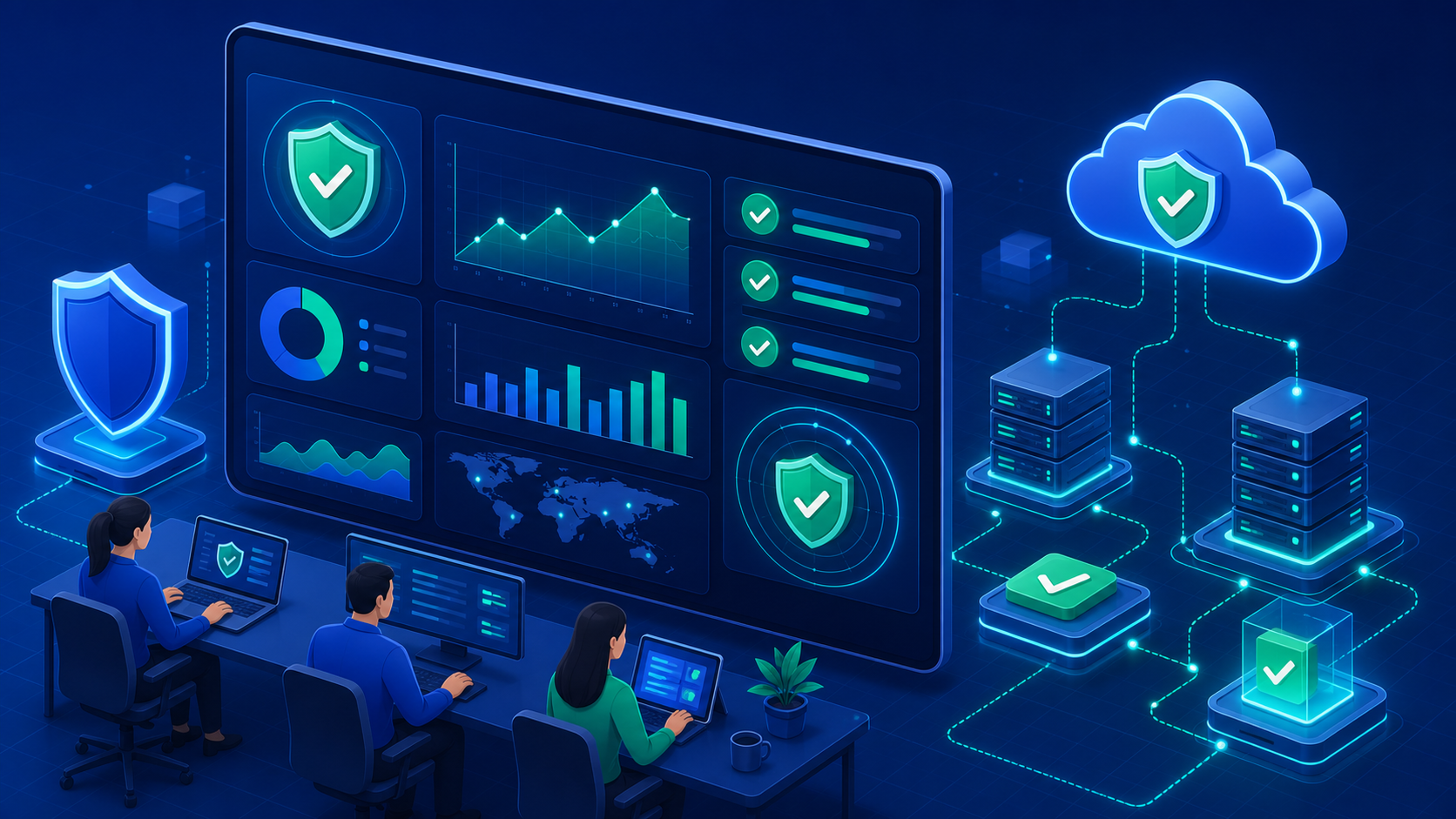
SOC 2 continuous monitoring has shifted from a "nice-to-have" security practice to a foundational requirement for any organization serious about maintaining its Trust Services Criteria year-round — not just during audit season. Unlike point-in-time assessments that capture a snapshot of your controls, continuous monitoring gives auditors, customers, and your own security team real-time confidence that your environment is operating as intended. In this guide, we break down exactly which tools to use, how frequently to run each monitoring activity, and how to collect audit-ready evidence without drowning your team in manual work.
Why SOC 2 Continuous Monitoring Matters Beyond the Annual Audit
Most SMBs treat SOC 2 compliance as a sprint: scramble to gather evidence, pass the audit, then coast until the next one. The problem is that auditors are increasingly scrutinizing the consistency of controls over time, not just their existence at a single moment. The AICPA's Trust Services Criteria explicitly require that controls operate effectively throughout the audit period — typically 6 or 12 months for a Type II report.
Beyond audit requirements, continuous monitoring delivers tangible operational benefits:
- Faster breach detection: The average time to identify a breach is still measured in weeks or months. Real-time alerting compresses that window dramatically.
- Reduced remediation cost: Control failures caught early are exponentially cheaper to fix than those discovered during an audit or, worse, after a customer incident.
- Customer trust signals: Enterprise buyers increasingly ask for evidence of ongoing monitoring, not just a dated SOC 2 report.
- Audit efficiency: When evidence is collected continuously and automatically, your audit prep time drops from weeks to days.
The Core Domains of SOC 2 Continuous Monitoring
Continuous monitoring isn't a single tool or process — it's a program that spans multiple Trust Services Criteria domains. Here's how to think about each one:
1. Access Control Monitoring
Access-related controls are the most frequently tested in SOC 2 audits and the most common source of findings. Your continuous monitoring program should track:
- User provisioning and deprovisioning events (especially offboarding within 24 hours of termination)
- Privileged access usage — who used admin credentials, when, and from where
- Multi-factor authentication (MFA) enrollment rates and bypass events
- Access reviews completed on schedule (typically quarterly)
- Dormant account detection — accounts inactive for 30, 60, or 90 days
Tools like Okta, Azure Active Directory, and Google Workspace all expose audit logs that can be ingested into a SIEM or compliance platform. The key is not just collecting these logs but generating structured evidence artifacts that map directly to specific SOC 2 controls.
2. Vulnerability and Patch Management Monitoring
The CC7.1 and CC7.2 controls under the Common Criteria require organizations to identify and address vulnerabilities on a defined schedule. Continuous monitoring here means:
- Running authenticated vulnerability scans at least monthly (weekly for high-risk environments)
- Tracking mean time to remediate (MTTR) by severity — critical vulnerabilities should be patched within 30 days at most, ideally 15
- Monitoring patch compliance rates across your endpoint fleet
- Alerting on newly disclosed CVEs that affect your technology stack
Tools like Tenable, Qualys, and Rapid7 are common choices. For SMBs, cloud-native options like AWS Inspector or Microsoft Defender Vulnerability Management offer lower-cost entry points with solid API integrations.
3. Infrastructure and Configuration Monitoring
Drift from your approved baseline configuration is one of the sneakiest ways SOC 2 controls fail silently. Continuous configuration monitoring should cover:
- Cloud security posture management (CSPM) — detecting misconfigured S3 buckets, open security groups, public-facing databases
- Infrastructure-as-code (IaC) policy enforcement to catch misconfigurations before deployment
- Baseline configuration drift alerts for servers, containers, and network devices
- Encryption status monitoring for data at rest and in transit
Tools like Wiz, Orca Security, Lacework, and the open-source Prowler are widely used for cloud environments. For on-premises infrastructure, CIS Benchmarks provide the configuration standards, and tools like Chef InSpec or Ansible can automate compliance checks against them.
4. Incident Detection and Response Monitoring
SOC 2's CC7.3 and CC7.4 controls require that you detect, respond to, and document security incidents. Your monitoring program should include:
- SIEM alerting with defined detection rules mapped to your threat model
- Incident ticket creation, escalation, and closure tracking
- Mean time to detect (MTTD) and mean time to respond (MTTR) metrics reported monthly
- Tabletop exercise completion records (at least annually)
5. Vendor and Third-Party Risk Monitoring
Your SOC 2 scope almost certainly includes third-party services. Continuous vendor monitoring means:
- Tracking vendor SOC 2 report expiration dates and requesting updated reports annually
- Monitoring vendor security ratings via tools like SecurityScorecard or BitSight
- Alerting on vendor data breach disclosures that affect your supply chain
- Reviewing vendor contracts for data processing agreements and security addenda
Building Your SOC 2 Continuous Monitoring Cadence
One of the most practical questions compliance teams ask is: how often should we actually be doing this? The answer depends on the control, your risk tolerance, and your auditor's expectations. The table below provides a defensible baseline cadence:
| Monitoring Activity | Recommended Frequency | Evidence Artifact |
|---|---|---|
| User access review | Quarterly | Signed access review report with approver attestation |
| Privileged access log review | Monthly | Exported log with anomaly annotations |
| Vulnerability scan | Monthly (critical systems: weekly) | Scan report with remediation status |
| Patch compliance check | Weekly | Endpoint compliance dashboard export |
| Cloud configuration posture review | Continuous / daily alert digest | CSPM findings report with remediation tickets |
| Incident log review | Monthly | Incident register with status and resolution notes |
| Vendor SOC 2 report review | Annually (or upon renewal) | Vendor assessment record with report copy |
| Security awareness training completion | Annually (phishing: quarterly) | LMS completion report |
| Business continuity / DR test | Annually | Test results report with lessons learned |
The NIST Cybersecurity Framework provides additional guidance on monitoring frequencies aligned to risk tiers, which can help you justify your cadence choices to auditors.
Evidence Collection: Turning Monitoring Data Into Audit-Ready Proof
Monitoring without structured evidence collection is like running a security camera with no recording. Your auditor needs to see not just that a control exists, but that it operated consistently throughout the audit period. Here's what makes evidence audit-ready:
Characteristics of Strong SOC 2 Evidence
- Timestamped and tamper-evident: Evidence should carry a clear date and ideally be exported directly from the source system rather than manually compiled.
- Mapped to a specific control: Each piece of evidence should be tagged to the Trust Services Criteria criterion it satisfies (e.g., CC6.1, CC7.2).
- Complete for the audit period: For a 12-month Type II audit, you need 12 months of consistent evidence — not just the last three months.
- Reviewed and attested: Evidence of review (who reviewed it, when, and what action was taken) is often more valuable than the raw data itself.
Common Evidence Collection Mistakes to Avoid
- Screenshot-only evidence: Screenshots are easy to manipulate and hard to verify. Prefer system-generated exports with metadata.
- Gaps in the timeline: Missing a monthly log review in March creates a gap that auditors will flag. Automate reminders and escalations.
- Undocumented exceptions: If a control failed or was temporarily bypassed, document the exception, the reason, and the compensating control. Undocumented exceptions are far worse than documented ones.
- Evidence stored in personal drives: Evidence should live in a centralized, access-controlled repository — not in someone's Google Drive or email inbox.
Tools That Power SOC 2 Continuous Monitoring Programs
The right toolset depends on your stack, team size, and budget. Here's a practical breakdown by category:
- SIEM / Log Management: Splunk, Datadog, Elastic SIEM, Sumo Logic, Microsoft Sentinel
- Cloud Security Posture Management: Wiz, Orca, Lacework, Prisma Cloud, AWS Security Hub
- Vulnerability Management: Tenable.io, Qualys, Rapid7 InsightVM, Snyk (for code)
- Identity and Access: Okta, Azure AD, JumpCloud, BeyondTrust (for PAM)
- Compliance Automation: Platforms like ComplyGuard aggregate evidence from all of these tools, map it to SOC 2 controls automatically, and flag gaps before your auditor does
- Endpoint Management: Jamf, Kandji, Microsoft Intune, CrowdStrike Falcon
The challenge for most SMBs isn't a lack of tools — it's the lack of a system that connects them. A dedicated compliance automation platform eliminates the spreadsheet chaos of manually correlating evidence from a dozen different sources. If you're evaluating options, our platform comparison page breaks down how ComplyGuard stacks up against alternatives on evidence automation, auditor collaboration, and control coverage.
Operationalizing Continuous Monitoring Without a Large Security Team
Many SMBs assume that a robust continuous monitoring program requires a dedicated security operations center. It doesn't — but it does require intentional process design. Here are the key operational levers:
- Automate evidence collection at the source: Use API integrations to pull evidence directly from your tools on a schedule. Manual collection is the enemy of consistency.
- Assign control owners, not just a compliance lead: Each control should have a named owner who is responsible for monitoring and evidence submission. Distribute the load.
- Build monitoring into existing workflows: Patch reviews happen in your ticketing system anyway — make sure the output is captured as compliance evidence automatically.
- Use risk-based prioritization: Not all controls carry equal audit weight. Focus your highest-frequency monitoring on controls that are most likely to fail and most likely to be tested.
- Run internal control tests quarterly: Don't wait for your auditor to find gaps. Treat quarterly internal reviews as mini-audits and remediate findings before they become report findings.
The NIST SP 800-137 guide on information security continuous monitoring provides a rigorous framework for building a tiered monitoring program that scales with your organization's risk profile — well worth reviewing as you mature your program.
Conclusion
SOC 2 continuous monitoring is the difference between a compliance program that holds up under scrutiny and one that falls apart the moment an auditor asks for six months of evidence. By establishing a clear monitoring cadence, collecting structured and timestamped evidence, and connecting your security tools into a unified compliance workflow, you transform SOC 2 from an annual fire drill into a steady-state operational discipline. The organizations that do this well don't just pass audits — they close enterprise deals faster, respond to security incidents more effectively, and build the kind of trust that becomes a genuine competitive advantage.
Ready to stop stitching together spreadsheets and start running a real continuous monitoring program? ComplyGuard automates evidence collection, maps findings to SOC 2 controls in real time, and gives your auditor a clean, organized evidence package — all without hiring a consultant. Explore our pricing plans to see how affordable enterprise-grade compliance automation can be, or talk to our team to get a personalized walkthrough of how ComplyGuard fits your environment.