SOC 2 Change Management Policy: Requirements & Templates
A well-defined SOC 2 change management policy is one of the most scrutinized controls during a Type II audit — and one of the most common reasons organizations receive qualified opinions or extended remediation timelines. Whether you're preparing for your first SOC 2 audit or tightening controls ahead of a renewal, understanding exactly what auditors expect, how to document it, and how to operationalize it across your engineering and IT teams is critical to passing with confidence.
What Is a SOC 2 Change Management Policy?
Change management, in the context of SOC 2, refers to the formal processes your organization uses to plan, review, approve, test, and document changes to systems, infrastructure, applications, and configurations that are in scope for your audit. It falls under the Common Criteria (CC8) category of the AICPA's Trust Services Criteria — specifically CC8.1, which addresses change management controls.
The AICPA Trust Services Criteria require that entities implement controls to manage changes to infrastructure, data, software, and procedures in a way that prevents unauthorized modifications and maintains the integrity, availability, and confidentiality of systems.
A SOC 2 change management policy is the written document that defines:
- What constitutes a "change" requiring formal review
- Who has authority to approve changes
- How changes are tested before deployment
- How emergency or hotfix changes are handled
- How changes are logged, tracked, and reviewed post-deployment
Why Auditors Focus Heavily on Change Management
Change management sits at the intersection of security, availability, and processing integrity — three of the five Trust Service Categories. Unauthorized or poorly tested changes are a leading cause of security incidents, data breaches, and system outages. Auditors want evidence that your organization doesn't just have a policy on paper, but that it's consistently followed across every sprint, release cycle, and infrastructure update.
During a SOC 2 Type II audit, auditors will typically request:
- A copy of your written change management policy
- A sample of change tickets or pull requests from the audit period
- Evidence of peer review or approval before deployment
- Separation of duties documentation (the developer who writes code shouldn't be the only one who deploys it)
- Records of testing (unit tests, staging environment validation, QA sign-off)
- Emergency change logs with post-incident reviews
If your team is using GitHub, Jira, or a CI/CD pipeline, much of this evidence can be pulled automatically — but only if your policy aligns with how those tools are actually configured and used.
Core Components of a SOC 2 Change Management Policy
A compliant policy doesn't need to be 40 pages long, but it does need to be specific, enforceable, and reflective of your actual practices. Below are the essential sections every SOC 2 change management policy should include.
1. Scope and Purpose
Define which systems, environments, and teams are covered. Be explicit: does this policy apply to production infrastructure only, or also to staging? Does it cover third-party SaaS tools that process customer data? Auditors will check whether your scope matches your System Description.
2. Change Classification
Not all changes carry the same risk. A well-structured policy categorizes changes to ensure the right level of scrutiny is applied:
| Change Type | Description | Approval Required |
|---|---|---|
| Standard | Pre-approved, low-risk, routine changes (e.g., dependency updates) | Peer review only |
| Normal | Planned changes with moderate risk (e.g., new feature releases) | Engineering lead + QA sign-off |
| Major | High-impact changes affecting core architecture or data flows | Change Advisory Board (CAB) or CTO |
| Emergency | Urgent fixes to address active incidents or critical vulnerabilities | Post-deployment review within 24–48 hours |
3. Change Request and Approval Workflow
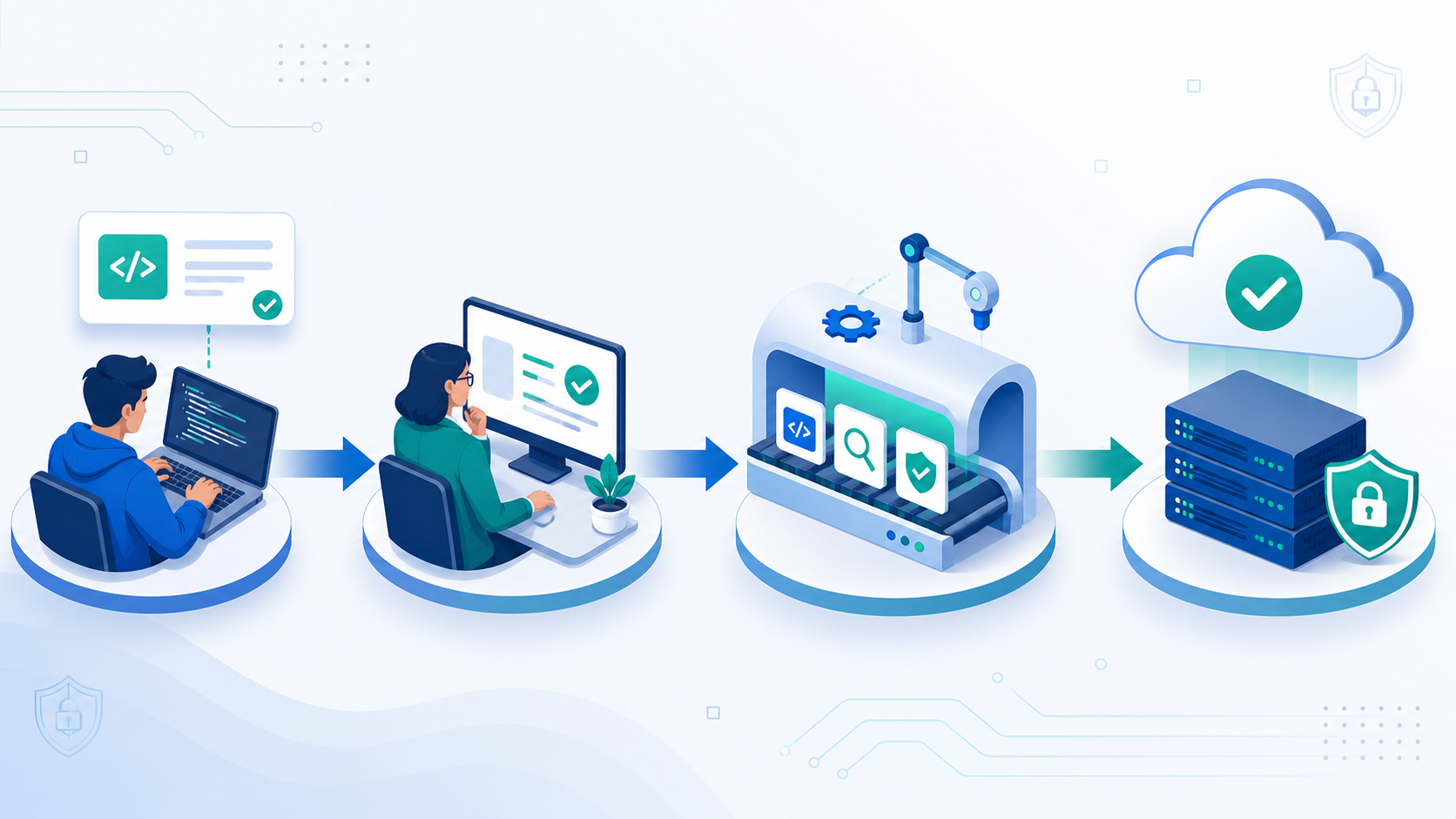
Document the step-by-step process for submitting, reviewing, and approving a change. This should map directly to your ticketing system. For example:
- Developer opens a pull request or change ticket with a description, risk assessment, and rollback plan
- At least one peer reviewer approves the code or configuration change
- QA validates in a non-production environment
- Designated approver (engineering lead, change manager) gives final sign-off
- Change is deployed during an approved maintenance window
- Post-deployment validation is documented
4. Separation of Duties
This is a non-negotiable for SOC 2. The person who develops a change should not be the sole person who approves and deploys it to production. For small teams, this can be challenging — but auditors understand startup realities. What they want to see is a documented compensating control if strict separation isn't feasible (e.g., mandatory peer review, automated deployment gates, or logging of all production access).
5. Testing Requirements
Specify what testing must occur before a change reaches production. This typically includes unit testing, integration testing, and user acceptance testing (UAT) for significant changes. Reference your staging or pre-production environment and document how it mirrors production.
6. Emergency Change Procedures
Hotfixes happen. Your policy must acknowledge this and define a controlled process: who can authorize an emergency change, what abbreviated testing is acceptable, and — critically — that a full post-deployment review must occur within a defined timeframe. Auditors will look for evidence that emergency changes aren't being used to bypass normal controls routinely.
7. Rollback Procedures
Every change request should include a documented rollback plan. Define how quickly a rollback must be executable and who is responsible for initiating it if a deployment causes issues.
8. Documentation and Audit Trail
All changes must be logged with timestamps, approver names, test results, and deployment outcomes. This is your evidence package for auditors. Tools like GitHub (branch protection rules, required reviewers), Jira (workflow states, approval fields), and ServiceNow (change records) can automate much of this if configured correctly.
SOC 2 Change Management Policy Template: Key Language to Include
While every organization's policy will differ based on size, tech stack, and risk profile, the following language reflects what auditors expect to see. You can adapt this as a starting point:
"All changes to production systems, applications, and infrastructure must be submitted via [ticketing system] and include a description of the change, associated risk level, testing evidence, and rollback plan. Changes classified as Normal or Major require approval from at least one designated approver prior to deployment. Emergency changes may be deployed with verbal authorization from [role] but must be formally documented and reviewed within 48 hours of deployment. Separation of duties must be maintained such that no individual can both develop and unilaterally deploy a change to production without a secondary review."
This kind of specific, operational language is far more valuable to auditors than vague statements like "we follow best practices for change management."
Common Gaps That Lead to Audit Findings
Based on patterns seen across hundreds of SOC 2 audits, these are the most frequent change management deficiencies:
- Policy doesn't match practice: The written policy says changes require two approvers, but pull request logs show single-approver merges throughout the audit period.
- Emergency changes are overused: More than 20–30% of changes classified as "emergency" is a red flag that normal controls are being bypassed.
- No evidence of testing: Deployment logs exist, but there's no documentation of what was tested or who validated it.
- Incomplete rollback plans: Change tickets exist but lack rollback procedures, making it unclear whether risk was properly assessed.
- Scope gaps: Infrastructure-as-code changes, database schema changes, or third-party configuration changes aren't covered by the policy.
Aligning Your Change Management Policy with Other SOC 2 Controls
Change management doesn't exist in isolation. It intersects with several other Trust Services Criteria controls that auditors will evaluate holistically:
- CC6.1 (Logical Access Controls): Who has access to deploy to production? Access should be restricted and reviewed regularly.
- CC7.2 (Monitoring of System Components): Post-deployment monitoring should detect anomalies introduced by changes.
- CC9.2 (Risk Mitigation): Your change risk classification process should tie into your broader risk management framework.
- A1.2 (Availability — Capacity Management): Changes that affect system capacity or performance should be evaluated for availability impact.
If you're also pursuing ISO 27001 or building toward it, note that ISO 27001 Annex A Control 8.32 similarly requires documented change management procedures — so a well-built SOC 2 policy can serve double duty. Platforms like ComplyGuard's compliance comparison tool can help you map overlapping controls across frameworks to avoid duplicating effort.
How to Operationalize Your SOC 2 Change Management Policy
Writing the policy is only half the battle. The harder part is ensuring your engineering team actually follows it consistently over a 12-month Type II audit period. Here's how high-performing compliance teams make it stick:
Automate Evidence Collection
Configure your version control system to enforce branch protection rules, require a minimum number of reviewers, and block direct pushes to main or production branches. Every merge then automatically generates an audit-ready record. Tools that integrate with your CI/CD pipeline can capture test results and deployment logs without any manual effort.
Train Your Team — and Document It
Auditors will ask whether employees have been trained on your change management policy. Annual security awareness training should include a module on change management procedures, and you should retain completion records.
Conduct Quarterly Policy Reviews
Your policy should include a review cadence (at minimum annually, ideally quarterly). Document who reviewed it, what changes were made, and why. This demonstrates that your compliance program is living and active, not a one-time checkbox exercise.
Use a Compliance Automation Platform
Manually tracking change management evidence across a 12-month audit period is time-consuming and error-prone. ComplyGuard's automated evidence collection features integrate directly with GitHub, Jira, and AWS to continuously capture change management artifacts, flag policy violations in real time, and generate audit-ready reports — dramatically reducing the burden on your engineering team.
According to NIST's Cybersecurity Framework, continuous monitoring and automated control validation are foundational to a mature security posture — and they're increasingly what SOC 2 auditors expect to see from technology companies.
Conclusion
A robust SOC 2 change management policy is far more than a compliance checkbox — it's a foundational control that protects your systems, builds customer trust, and demonstrates operational maturity to enterprise buyers and auditors alike. From defining change classifications and approval workflows to enforcing separation of duties and automating evidence collection, every element of your policy needs to be specific, enforceable, and consistently practiced throughout your audit period. The organizations that pass SOC 2 audits cleanly aren't the ones with the longest policies — they're the ones whose policies match their actual operations and whose teams have the tools to prove it.
Ready to stop building compliance programs from scratch? ComplyGuard's SOC 2 automation platform gives you pre-built policy templates, automated evidence collection, and real-time control monitoring — so you can achieve SOC 2 compliance in weeks, not months, without expensive consultants. Talk to our compliance team today and see how ComplyGuard can take the guesswork out of your next audit.