SOC 2 Access Control Policy: Templates & Auditor Tips
A well-crafted SOC 2 access control policy is one of the most scrutinized documents an auditor will request during your Type I or Type II examination — and one of the most common reasons audits stall or fail. Whether you're preparing for your first SOC 2 audit or tightening controls ahead of a renewal, understanding exactly what auditors expect, what your policy must cover, and how to avoid the gaps that trigger findings can save you weeks of remediation work and thousands of dollars in consultant fees.
Why Your SOC 2 Access Control Policy Is Auditor Priority #1
Access control sits at the heart of the AICPA's Trust Services Criteria (TSC), specifically under the Common Criteria (CC) series — CC6.1 through CC6.8. These criteria govern how your organization restricts logical and physical access to systems, data, and infrastructure. Auditors spend a disproportionate amount of time here because access control failures are the root cause of the majority of data breaches and compliance violations.
What makes access control particularly tricky for SMBs is that auditors aren't just checking whether a policy document exists. They're verifying that the policy is implemented, enforced, and evidenced consistently over the audit period. A policy that lives in a Google Doc but isn't reflected in your actual user provisioning workflows is worse than no policy at all — it signals a gap between documentation and reality.
The relevant TSC criteria you need to address include:
- CC6.1 — Logical access security software, infrastructure, and architectures
- CC6.2 — New internal and external users, and changes to user access
- CC6.3 — Role-based access and the principle of least privilege
- CC6.6 — Logical access restrictions for external parties
- CC6.7 — Transmission of data and encryption controls
- CC6.8 — Prevention and detection of unauthorized or malicious software
Core Components Every SOC 2 Access Control Policy Must Include
Auditors follow a structured review process. Your policy document needs to address each of the following areas with enough specificity to demonstrate operational intent — not just aspirational language.
1. Scope and Applicability
Define which systems, environments, personnel, and third parties the policy applies to. Be explicit: does it cover your production environment only, or also staging and development? Does it apply to contractors and vendors? Vague scope statements are a red flag for auditors who need to map your policy to actual system boundaries.
2. User Provisioning and Deprovisioning
This is where most SMBs have their first finding. Your policy must describe the end-to-end lifecycle of a user account:
- How access requests are submitted and approved (ideally with a ticketing or workflow system)
- Who has authority to approve access to sensitive systems
- The maximum time allowed between an employee termination and account deactivation (auditors love to test this — 24 hours is a common benchmark)
- How access is revoked for contractors and third-party vendors
Auditors will pull a sample of terminated employees from your HR system and cross-reference them against active accounts in your identity provider (Okta, Azure AD, Google Workspace, etc.). If any terminated users still have active accounts, you have a finding.
3. Principle of Least Privilege
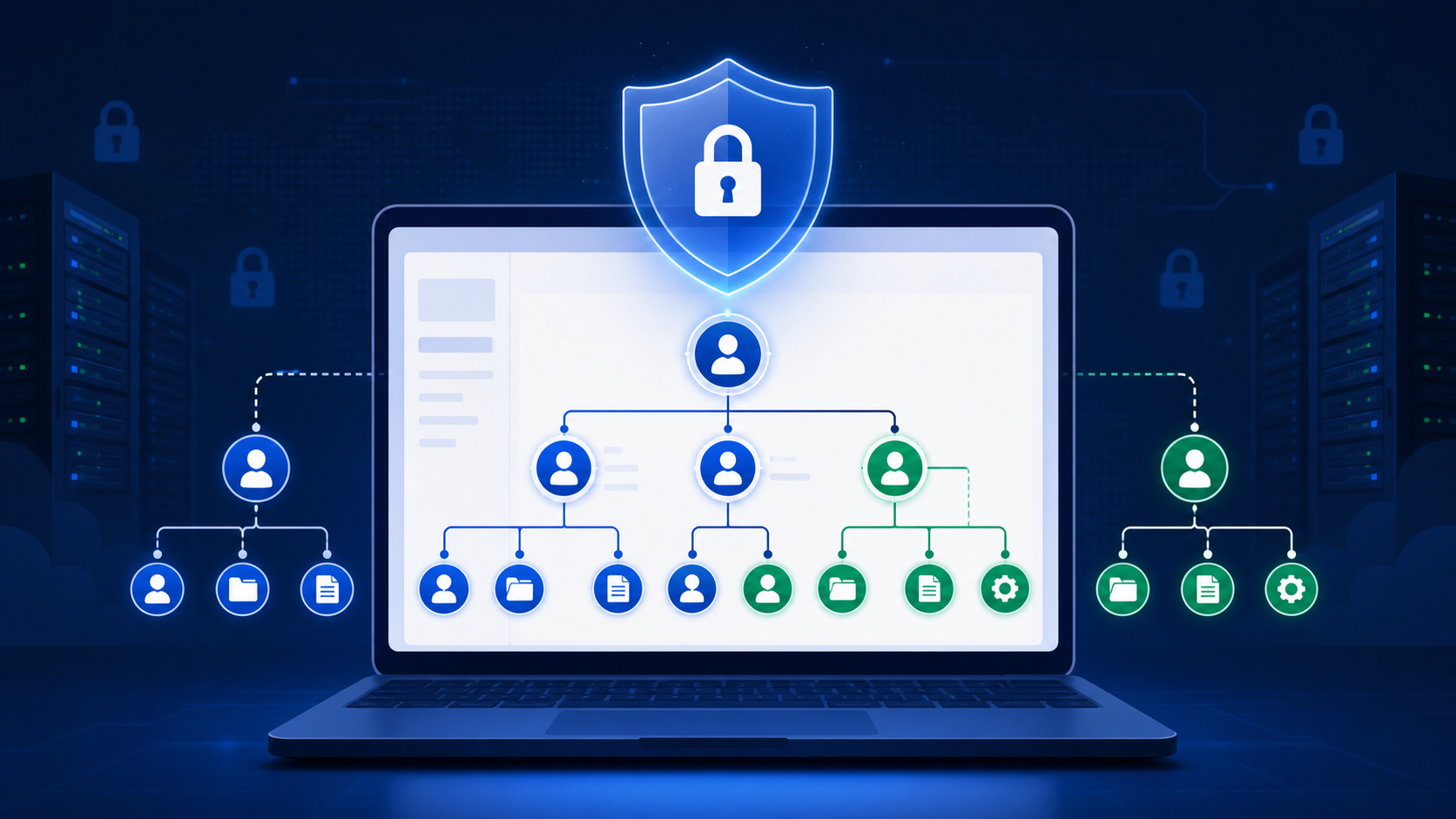
Your policy must explicitly state that users are granted only the minimum access necessary to perform their job functions. More importantly, you need to demonstrate how this is enforced in practice. This means documenting your role definitions, showing that access reviews are conducted periodically (quarterly is the gold standard), and evidencing that privileged access — admin rights, root access, database superuser — is tightly controlled and logged.
4. Multi-Factor Authentication (MFA)
MFA is no longer optional for SOC 2. Your policy should mandate MFA for all users accessing production systems, administrative consoles, cloud infrastructure, and any system containing customer data. Specify the acceptable MFA methods (TOTP apps, hardware keys) and explicitly prohibit SMS-only MFA for privileged accounts where possible.
5. Privileged Access Management
Privileged accounts — those with elevated permissions — require their own section. Auditors will look for:
- A documented inventory of all privileged accounts
- Justification for each privileged account's existence
- Evidence that privileged sessions are logged and monitored
- Prohibition of shared or generic admin accounts
- Just-in-time (JIT) access provisioning where feasible
6. Access Reviews
Periodic access reviews (also called user access recertification) are a mandatory control. Your policy should specify the frequency (quarterly for privileged access, semi-annual for standard users is common), who conducts the review, and what happens when inappropriate access is identified. Critically, you need to retain evidence of completed reviews — screenshots, exported reports, or signed-off spreadsheets — for the entire audit period.
7. Remote Access and VPN Controls
Define how remote access to internal systems is controlled. This includes VPN requirements, split-tunneling policies, and controls for employees working from personal devices. If you allow BYOD, your policy needs to address minimum security requirements for those devices.
8. Physical Access Controls
Even for cloud-native companies, auditors may ask about physical access to offices where sensitive data is processed. If you use a data center or colocation facility, reference your vendor's physical access controls and include relevant sections of their SOC 2 report (a sub-service organization carve-out).
SOC 2 Access Control Policy Template: Key Sections at a Glance
The table below outlines the essential policy sections, the corresponding TSC criteria, and the evidence auditors typically request for each:
| Policy Section | TSC Criteria | Evidence Auditors Request |
|---|---|---|
| User Provisioning | CC6.1, CC6.2 | Access request tickets, approval records, HR onboarding logs |
| Deprovisioning / Offboarding | CC6.2 | Termination checklists, account deactivation timestamps vs. HR termination dates |
| Least Privilege / RBAC | CC6.3 | Role definitions, access matrix, provisioning approval records |
| MFA Enforcement | CC6.1, CC6.6 | MFA configuration screenshots, policy enforcement reports from IdP |
| Privileged Access Management | CC6.1, CC6.3 | Privileged account inventory, session logs, JIT access records |
| Access Reviews | CC6.3 | Completed review reports, manager sign-offs, remediation tickets |
| Remote Access | CC6.6, CC6.7 | VPN configuration, device compliance reports |
Common Auditor Findings — and How to Avoid Them
Having reviewed hundreds of SOC 2 audit reports, the same findings appear repeatedly. Here's what to watch for before your auditor does:
Finding #1: Stale Accounts for Terminated Employees
This is the single most common access control finding. The fix isn't just updating your policy — it's building an automated workflow that triggers account deactivation the moment HR marks an employee as terminated. Tools like Okta Lifecycle Management, Azure AD automated provisioning, or a dedicated identity governance platform can close this gap. Your policy should specify the SLA (e.g., "accounts will be disabled within 4 business hours of termination notification").
Finding #2: Undocumented Access Reviews
Many companies conduct access reviews informally — a manager glances at a list and says "looks fine." Auditors need documented evidence. Use a structured process: export your user list from your IdP, have managers certify each user's access in writing, document any removals made as a result, and retain the completed records. Platforms like ComplyGuard automate this entire workflow, generating audit-ready evidence automatically.
Finding #3: Shared Admin Credentials
Shared admin accounts make it impossible to attribute actions to specific individuals, which violates the non-repudiation principle underlying CC6.1. Every privileged user must have their own named account. If a system doesn't support individual admin accounts, document the compensating control (e.g., session recording, approval workflows before use).
Finding #4: MFA Gaps for Critical Systems
Auditors will test MFA enforcement by attempting to identify systems where it can be bypassed. Common gaps include legacy applications that don't support modern MFA, service accounts with interactive login capabilities, and cloud console access not routed through your SSO provider. Map every system in scope and document how MFA is enforced — or what compensating controls exist where it isn't technically feasible.
Finding #5: Policy Language That Doesn't Match Reality
If your policy says "access reviews are conducted quarterly" but your evidence shows they were done once in 18 months, you have a more serious problem than if you'd never written the policy. Auditors call this a "design vs. operating effectiveness" failure. Write policies that reflect what you can actually sustain operationally, then build the processes to support them.
Practical Tips Straight from the Auditor's Perspective
Beyond the policy document itself, experienced auditors evaluate the maturity of your access control program holistically. Here are insider tips that can meaningfully improve your audit outcome:
- Version control your policy. Auditors want to see that your policy was in effect during the audit period. Use a document management system that timestamps versions and captures approvals.
- Link your policy to your controls inventory. Each policy statement should map to a specific control, which maps to specific evidence. This traceability is what separates mature compliance programs from checkbox exercises.
- Conduct a pre-audit access review. Before your audit window opens, run a full access review and remediate any issues. This gives you clean evidence from the start of the period.
- Document exceptions formally. If a user needs access that deviates from your standard policy, document the business justification, the approver, and the compensating controls. Undocumented exceptions become findings; documented ones become evidence of a mature risk management process.
- Reference the NIST SP 800-53 Access Control family when designing your controls. While SOC 2 uses the TSC framework, NIST 800-53 provides granular implementation guidance that maps well to SOC 2 requirements and demonstrates control sophistication to auditors.
Aligning Your Access Control Policy with Other Frameworks
If your organization is pursuing multiple compliance frameworks simultaneously — a common scenario for SMBs selling to enterprise customers — your access control policy can be written to satisfy multiple requirements at once. The ISO 27001 Annex A.9 (Access Control) requirements align closely with SOC 2 CC6, and HIPAA's Technical Safeguards under 45 CFR §164.312 share significant overlap as well.
A unified access control policy that maps to multiple frameworks reduces documentation overhead and makes cross-framework audits significantly more efficient. See how ComplyGuard maps controls across SOC 2, ISO 27001, HIPAA, and other frameworks in a single unified control library — eliminating the need to maintain separate policy documents for each standard.
Conclusion
Building a defensible SOC 2 access control policy isn't about writing the longest document or using the most technical language — it's about creating a living, operational framework that your team actually follows and that generates consistent, audit-ready evidence over time. Cover the core components: provisioning, deprovisioning, least privilege, MFA, privileged access, and access reviews. Avoid the common findings that trip up even well-prepared organizations. And make sure your policy reflects reality, not aspiration.
If you're ready to stop building compliance programs from scratch and start generating audit-ready policies, evidence, and control mappings automatically, explore ComplyGuard's pricing plans — or talk to our compliance team to see how we help SMBs achieve SOC 2 compliance in weeks, not months, without the six-figure consultant bill.