How to Write a HIPAA Business Associate Agreement: Template and Common Mistakes
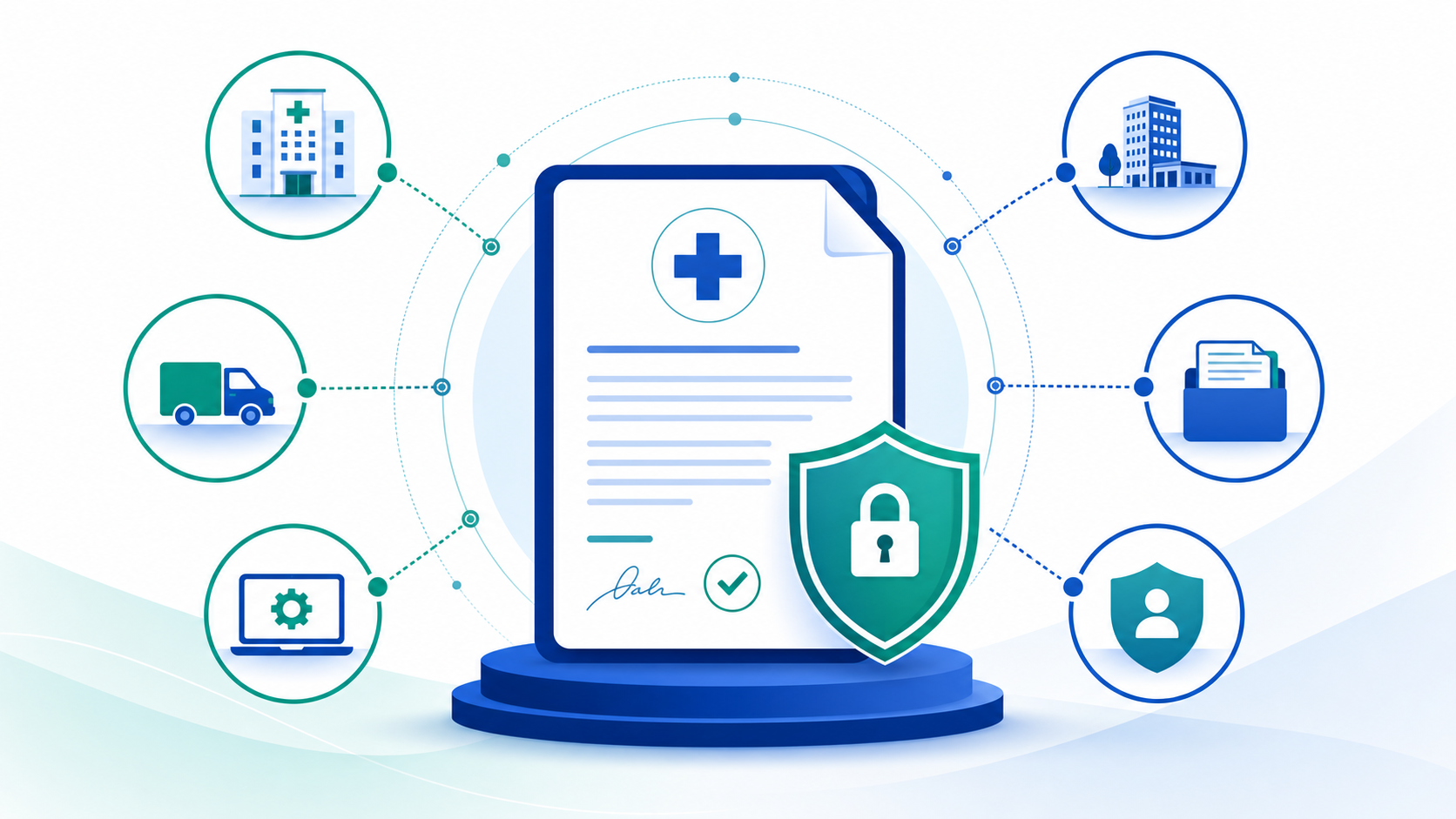
If your organization shares protected health information (PHI) with any third-party vendor — a cloud storage provider, billing service, or IT support firm — you are legally required to have a signed HIPAA business associate agreement template in place before a single byte of data changes hands. Getting this document wrong isn't just a paperwork problem; OCR fines for missing or deficient BAAs have reached into the millions of dollars. This guide walks you through exactly what a compliant BAA must contain, a practical template structure you can adapt, and the most common mistakes that expose covered entities and business associates to serious liability.
What Is a HIPAA Business Associate Agreement?
A Business Associate Agreement (BAA) is a legally binding contract required under the HHS HIPAA Rules between a covered entity (CE) — such as a hospital, health plan, or healthcare clearinghouse — and any business associate (BA) that creates, receives, maintains, or transmits PHI on the CE's behalf. The requirement stems from the HIPAA Privacy Rule (45 CFR §164.502(e)) and the Security Rule (45 CFR §164.314(a)).
Business associates can include:
- Cloud service providers storing electronic health records
- Medical billing and coding companies
- IT managed service providers with system access
- Legal and accounting firms handling patient data
- Telehealth platform vendors
- Data analytics and AI companies processing clinical data
Importantly, the HITECH Act extended direct liability to business associates, meaning a BA can be fined directly by OCR even if the covered entity had a BAA in place — so both parties have skin in the game.
Required Elements of a HIPAA Business Associate Agreement Template
The HHS Office for Civil Rights specifies the minimum provisions every BAA must contain. A compliant HIPAA business associate agreement template should address all of the following elements:
1. Permitted Uses and Disclosures of PHI
The agreement must clearly define the specific purposes for which the business associate is authorized to use or disclose PHI. Vague language like "for business purposes" is insufficient. Be explicit: "BA may use PHI solely to provide medical billing services as described in the underlying Service Agreement dated [date]."
2. Prohibition on Unauthorized Use
The BAA must state that the BA will not use or disclose PHI in any manner that would violate the HIPAA Privacy Rule if done by the covered entity itself — with limited exceptions for the BA's own management, legal obligations, and data aggregation services.
3. Appropriate Safeguards
The BA must agree to implement administrative, physical, and technical safeguards that reasonably protect the confidentiality, integrity, and availability of electronic PHI (ePHI) in accordance with the HIPAA Security Rule. This section should reference the BA's obligation to conduct risk assessments and maintain security policies.
4. Subcontractor Requirements
If the BA uses subcontractors who will access PHI, the BAA must require the BA to obtain a written agreement from those subcontractors that imposes the same restrictions and conditions as the BAA itself. This creates a chain of accountability down the vendor stack.
5. Breach Notification Obligations
The BA must agree to notify the covered entity of any breach of unsecured PHI without unreasonable delay and no later than 60 days after discovery, per HHS Breach Notification Rule requirements. The BAA should specify the notification timeline, the information to be included in the notice, and the designated contact person.
6. Individual Rights Obligations
The BA must agree to support the covered entity in fulfilling individuals' rights under HIPAA, including:
- Access to their PHI (45 CFR §164.524)
- Amendment of PHI (45 CFR §164.526)
- Accounting of disclosures (45 CFR §164.528)
7. Availability of Books and Records
The BA must make its internal practices, books, and records relating to PHI available to the Secretary of HHS for purposes of determining compliance with HIPAA.
8. Termination Provisions
The BAA must include provisions for termination, including the covered entity's right to terminate the agreement if the BA materially breaches any term. Upon termination, the BA must return or destroy all PHI received from or created on behalf of the covered entity, if feasible.
HIPAA BAA Template Structure: A Practical Framework
Below is a structural outline you can use as the foundation for your own BAA. Always have legal counsel review the final document before execution.
| Section | Key Content | Regulatory Basis |
|---|---|---|
| Definitions | PHI, ePHI, Covered Entity, Business Associate, Breach | 45 CFR §160.103 |
| Obligations of BA | Permitted uses, safeguards, subcontractor BAAs, breach notice | 45 CFR §164.504(e)(2) |
| Obligations of CE | Notice of privacy practices, permission changes, restrictions | 45 CFR §164.504(e)(2)(ii) |
| Permitted Uses by BA | Management, legal, data aggregation (if applicable) | 45 CFR §164.504(e)(4) |
| Term and Termination | Duration, material breach clause, return/destroy PHI | 45 CFR §164.504(e)(2)(ii)(J) |
| Miscellaneous | Governing law, amendment process, entire agreement | Contract law |
Common Mistakes to Avoid in Your HIPAA Business Associate Agreement
Even organizations with good intentions make critical errors in their BAAs. Here are the most frequently cited deficiencies found during OCR investigations:
Mistake 1: Using a Generic or Outdated Template
Many organizations download a BAA template from the internet and never update it. The HITECH Act of 2009 and the Omnibus Rule of 2013 significantly expanded BAA requirements. A pre-2013 template is almost certainly non-compliant. Always verify your template reflects current regulatory requirements.
Mistake 2: Failing to Execute BAAs with All Applicable Vendors
This is the single most common HIPAA violation. Organizations often overlook vendors they don't think of as "healthcare" companies — their email marketing platform, their customer support ticketing system, or their cloud backup provider. If any of these systems could touch PHI, a BAA is required. Conduct a thorough vendor inventory at least annually.
Mistake 3: Vague Permitted Use Language
BAAs that permit PHI use "as necessary to perform services" without specificity create ambiguity that can be exploited. Define the services precisely and tie the BAA to a specific underlying service agreement.
Mistake 4: Missing or Inadequate Breach Notification Timelines
Some BAAs omit specific breach notification timelines or set timelines that conflict with the 60-day regulatory maximum. Worse, some agreements require the BA to notify the CE within 30 days but the CE's own breach response plan assumes 10 days of lead time — creating an operational mismatch. Align your BAA timelines with your internal incident response procedures.
Mistake 5: No Subcontractor Chain Requirements
If your BA uses AWS, Google Cloud, or any SaaS sub-processor that touches PHI, your BAA must require the BA to have its own BAA with those subcontractors. Failing to include this provision leaves a significant gap in your compliance chain.
Mistake 6: Treating the BAA as a One-Time Exercise
A BAA is a living document. When a vendor's services change, when new PHI data flows are introduced, or when your organization's privacy practices are updated, the BAA should be reviewed and amended accordingly. Set calendar reminders to review all BAAs at least annually.
Mistake 7: No Termination or Data Destruction Clause
Without a clear termination clause specifying how PHI must be returned or destroyed, you have no contractual recourse if a vendor retains your patients' data after the relationship ends. Specify the method, timeline, and certification of destruction.
How to Manage BAAs at Scale
For growing SMBs, manually tracking dozens of BAAs across spreadsheets is a recipe for missed renewals and compliance gaps. A structured vendor management program should include:
- A centralized BAA register listing every vendor, BAA execution date, renewal date, and PHI data flows involved
- Automated renewal reminders triggered 90 days before expiration
- Standardized BAA templates reviewed by legal counsel and version-controlled
- Vendor risk tiering so higher-risk BAs receive more rigorous due diligence
- Integration with your broader HIPAA compliance program including risk assessments and security policies
Platforms like ComplyGuard automate much of this process — from generating compliant BAA templates to tracking vendor agreements and sending renewal alerts — so your compliance team isn't buried in manual paperwork. You can also compare how ComplyGuard stacks up against traditional compliance approaches to see the time and cost savings firsthand.
What Happens If You Don't Have a BAA?
The consequences of operating without a required BAA are severe. Under the HHS Civil Money Penalty structure, violations can range from $100 to $50,000 per violation, with an annual cap of $1.9 million per violation category. OCR has levied multi-million dollar settlements specifically citing missing BAAs, including a $2.3 million settlement with a health system that failed to have BAAs with multiple vendors.
Beyond financial penalties, a missing BAA can:
- Trigger mandatory corrective action plans lasting 2-3 years
- Expose your organization to state attorney general enforcement
- Create civil liability if patients suffer harm from a breach
- Damage patient trust and organizational reputation irreparably
Conclusion: Build a Bulletproof HIPAA Business Associate Agreement Program
A well-drafted HIPAA business associate agreement template is not just a legal formality — it is a foundational pillar of your entire HIPAA compliance program. Getting it right means understanding the required provisions, avoiding the common drafting pitfalls, and treating BAA management as an ongoing operational discipline rather than a one-time checkbox. The stakes — financial, legal, and reputational — are simply too high to leave this to chance or outdated templates.
ComplyGuard makes it dramatically easier for SMBs to build and maintain a compliant BAA program without expensive outside counsel for every vendor agreement. From automated vendor tracking to pre-built, attorney-reviewed BAA templates aligned with current HHS guidance, our platform gives your team the tools to stay ahead of compliance requirements. Explore ComplyGuard's pricing plans to see how affordable enterprise-grade HIPAA compliance can be, or contact our compliance team today for a personalized walkthrough of how we can help you close your BAA gaps fast.