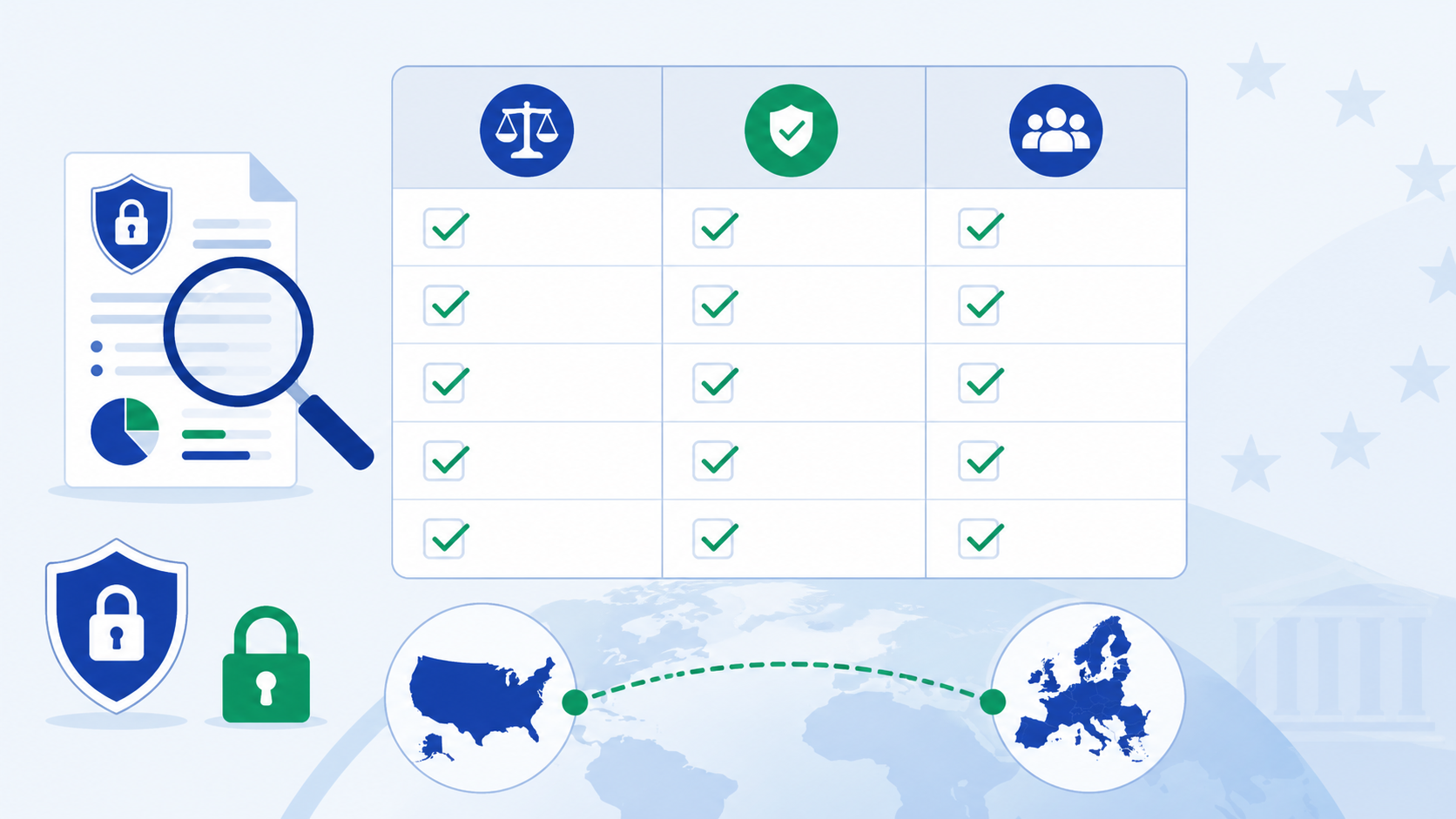
GDPR Compliance Checklist for U.S. SaaS Companies Selling to EU
If your U.S. SaaS company has even a single paying customer in the European Union, GDPR compliance for US SaaS companies is not optional — it is a legal obligation with teeth. The General Data Protection Regulation carries fines of up to €20 million or 4% of global annual turnover, whichever is higher, and EU regulators have shown no hesitation in pursuing non-European companies. This checklist gives you a practical, step-by-step roadmap to get compliant without drowning in legalese or burning your budget on consultants.
Does GDPR Actually Apply to Your U.S. SaaS Company?
Many American founders assume GDPR only applies to companies physically located in Europe. That assumption is wrong and expensive. Under Article 3 of the GDPR, the regulation applies to any organization — regardless of where it is based — that:
- Offers goods or services to individuals in the EU (even for free), or
- Monitors the behavior of individuals located in the EU (e.g., tracking website visitors via cookies or analytics).
In practice, this means if your SaaS product has a pricing page in euros, accepts EU-based sign-ups, or runs Google Analytics on traffic from Germany, you are almost certainly in scope. The official GDPR resource at gdpr.eu provides a plain-language breakdown of these territorial rules that is worth bookmarking.
GDPR Compliance for US SaaS Companies: The Core Checklist
Work through each section below systematically. These are not abstract principles — they are concrete actions your engineering, legal, and product teams need to execute.
1. Appoint a Legal Representative in the EU
If you have no establishment in the EU but process EU residents' data, Article 27 requires you to designate a written representative in an EU member state. This is a named individual or company that EU supervisory authorities can contact. Failing to appoint one is itself a violation, independent of any other breach.
2. Conduct a Data Mapping Exercise
You cannot protect data you do not know you have. A data mapping exercise documents:
- What personal data you collect (names, emails, IP addresses, behavioral data, payment info)
- Where it is stored (AWS us-east-1, third-party CRM, analytics platform)
- Who has access to it internally and externally
- How long you retain it and when it is deleted
This exercise feeds directly into your Records of Processing Activities (RoPA), which Article 30 requires most organizations to maintain. Document every data flow, including data shared with sub-processors like Stripe, Intercom, or HubSpot.
3. Establish a Lawful Basis for Every Processing Activity
Under GDPR, you cannot process personal data unless you have a documented lawful basis. The six lawful bases are:
- Consent — freely given, specific, informed, and unambiguous
- Contract — processing necessary to fulfill a contract with the data subject
- Legal obligation — required by EU or member state law
- Vital interests — protecting someone's life
- Public task — rarely applicable to SaaS companies
- Legitimate interests — your interests do not override the individual's rights
For most SaaS companies, contract covers core product usage data, consent covers marketing emails, and legitimate interests may cover fraud prevention or security logging — but each must be documented and defensible.
4. Rewrite Your Privacy Policy for GDPR
Your existing U.S.-style privacy policy almost certainly does not meet GDPR's transparency requirements. A compliant privacy notice must clearly state:
- The identity and contact details of the data controller (your company)
- Contact details for your EU representative and Data Protection Officer (if applicable)
- The lawful basis for each category of processing
- Data retention periods for each category
- All third-party recipients and sub-processors
- Data subject rights and how to exercise them
- The right to lodge a complaint with a supervisory authority
5. Build a Data Subject Rights Workflow
GDPR grants EU residents eight enforceable rights. You need a documented, tested process to respond to each within 30 days:
| Right | What It Requires | Common SaaS Trigger |
|---|---|---|
| Access (Art. 15) | Provide a copy of all personal data held | User requests data export |
| Rectification (Art. 16) | Correct inaccurate data | User updates profile info |
| Erasure (Art. 17) | Delete data on request ("right to be forgotten") | User closes account |
| Restriction (Art. 18) | Pause processing while a dispute is resolved | User contests data accuracy |
| Portability (Art. 20) | Provide data in machine-readable format | User migrates to competitor |
| Objection (Art. 21) | Stop processing for direct marketing | User opts out of emails |
| Automated Decision-Making (Art. 22) | Human review of automated decisions | AI-driven pricing or access decisions |
| Withdraw Consent (Art. 7) | Easy opt-out mechanism | Cookie consent withdrawal |
6. Execute Data Processing Agreements (DPAs) with All Sub-Processors
Every third-party vendor that processes EU personal data on your behalf is a sub-processor, and GDPR requires a written DPA with each one. This includes your cloud hosting provider, email platform, analytics tool, customer support software, and payment processor. Most major vendors (AWS, Google, Stripe, Intercom) offer standard DPAs — but you must actively sign and store them. Undocumented sub-processor relationships are a common audit failure point.
7. Address International Data Transfers
Transferring EU personal data to the United States requires a legal transfer mechanism. Since the invalidation of Privacy Shield in 2020, the primary options are:
- EU-U.S. Data Privacy Framework (DPF) — the current adequacy decision, in force since July 2023. U.S. companies can self-certify at dataprivacyframework.gov.
- Standard Contractual Clauses (SCCs) — updated 2021 versions from the European Commission, embedded in your DPAs.
- Binding Corporate Rules (BCRs) — for large multinational groups, not typically relevant for SMB SaaS.
Most U.S. SaaS companies should pursue DPF certification and supplement with SCCs in their vendor DPAs as a belt-and-suspenders approach.
8. Implement a Cookie Consent Management Platform
If your website or app uses cookies beyond strictly necessary ones — and virtually every SaaS product does — you need a compliant consent management platform (CMP). Key requirements:
- No pre-ticked boxes; consent must be an affirmative action
- Granular controls by cookie category (analytics, marketing, functional)
- Easy withdrawal of consent at any time
- Consent records stored with timestamps and version of policy shown
9. Create a Data Breach Response Plan
Article 33 requires you to notify the relevant supervisory authority within 72 hours of becoming aware of a personal data breach. Article 34 may require notifying affected individuals if the breach poses a high risk to their rights. Your incident response plan must include:
- Internal escalation procedures and a designated breach response owner
- A template for supervisory authority notification
- Criteria for assessing whether individual notification is required
- A breach log documenting all incidents, even those not reported externally
Platforms like ComplyGuard's automated compliance features can help you build and maintain incident response workflows that are audit-ready from day one.
10. Determine Whether You Need a Data Protection Officer (DPO)
A DPO is mandatory under Article 37 if your core activities involve large-scale systematic monitoring of individuals or large-scale processing of special category data (health, biometric, financial). Most standard B2B SaaS companies do not meet this threshold, but you should document your assessment. If you do need a DPO, they can be an employee or an external contractor.
11. Embed Privacy by Design into Your Product Development
Article 25 requires privacy by design and by default — meaning data protection must be built into your systems from the start, not bolted on afterward. Practical implementation includes:
- Data minimization: only collect what you genuinely need
- Default privacy settings: the most privacy-protective option should be the default
- Pseudonymization and encryption of personal data at rest and in transit
- Access controls limiting who can view personal data internally
GDPR Compliance for US SaaS Companies: Common Mistakes to Avoid
Even well-intentioned teams make predictable errors. Watch out for these:
- Treating consent as a universal lawful basis. Consent is actually one of the harder bases to maintain correctly. For core product functionality, contract or legitimate interests is usually more appropriate and more durable.
- Ignoring B2B data. If you process the personal data of employees at your business customers (names, work emails, usage logs), that data is still personal data under GDPR.
- Outdated sub-processor lists. Your privacy policy must reflect your current sub-processors. A list that was accurate 18 months ago is a liability today.
- No documented retention schedules. Saying you "delete data when no longer needed" is not sufficient. You need specific retention periods for each data category.
- Assuming SOC 2 equals GDPR. SOC 2 demonstrates security controls; GDPR is a legal framework with distinct requirements. They overlap but are not interchangeable. See how they compare on our compliance framework comparison page.
How to Prioritize If You Are Starting From Zero
If GDPR compliance feels overwhelming, sequence your work in three phases:
- Phase 1 — Foundations (Weeks 1–4): Data mapping, appoint EU representative, sign DPAs with major sub-processors, update privacy policy, implement cookie consent.
- Phase 2 — Operations (Weeks 5–8): Build data subject rights workflows, document lawful bases, create breach response plan, assess DPO requirement.
- Phase 3 — Maturity (Weeks 9–12): Privacy by design review, staff training, DPF certification, ongoing monitoring and annual review cycle.
Automation dramatically compresses this timeline. ComplyGuard's GDPR compliance automation maps your data flows, generates policy templates, tracks sub-processor agreements, and monitors your compliance posture continuously — so your team spends time on decisions, not documentation. You can explore plans on our pricing page to find the right fit for your stage.
Conclusion
GDPR compliance for US SaaS companies is genuinely achievable without a six-figure legal budget — but it requires systematic effort, clear ownership, and the right tools. The checklist above covers the eleven core obligations that EU regulators will scrutinize: from data mapping and lawful bases to breach response and international transfer mechanisms. The companies that get this right do not just avoid fines; they build the kind of data trust that accelerates enterprise sales cycles and opens doors to EU market segments that competitors cannot access. Ready to stop guessing and start complying? Talk to a ComplyGuard compliance specialist today and see how quickly your team can reach a defensible GDPR posture.